 -by
-by When I first started learning React, I was excited because I felt like I was finally moving from just knowing how to build simple websites to understanding how real applications are made.
I already had some experience with HTML and CSS, and I had even completed a few projects with them. Because of that, I thought learning React would be difficult but manageable.
I did not expect to feel so confused so quickly.
The experience became more challenging when I started working on a project with a team.
My responsibility was mainly the frontend, and I had to build the landing page using React and Tailwind CSS. The problem was that I was still a beginner in React.
I understood some basic JavaScript, but I was not completely comfortable with concepts like components, imports, exports, and how everything connected together. Suddenly, I was not just designing a page anymore. I had to understand how the code was structured and make sure everything worked together.
At first, I was excited. I created different components for different sections of the page, such as the Navbar, Hero, Security Section, Marketplace, and Footer.
Seeing the page slowly come together gave me a sense of progress. However, that excitement started to fade when I began running into problems.
One of the biggest things that frustrated me was making the website responsive.
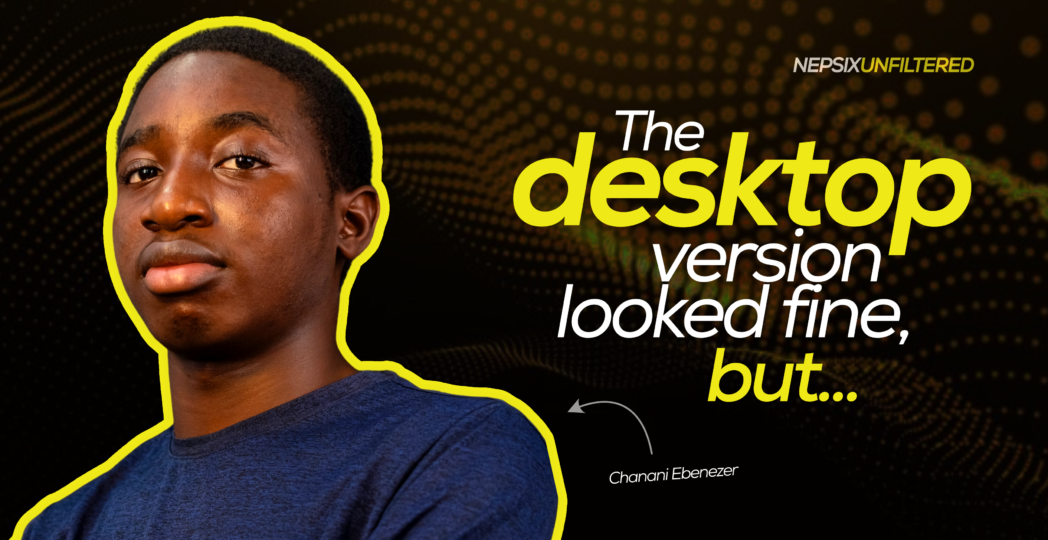
The desktop version looked fine, but when I had to make it match the mobile designs from Figma, I realized that I could not simply make everything smaller.
Some sections needed to change their spacing, layout, sizes, and even the way certain elements were displayed. I tried changing my Tailwind classes, and at one point I changed my Navbar and ended up with a white page because of an export error.
I remember feeling stuck because something that seemed like a small change had suddenly broken my page.
That moment made me question whether I actually understood what I was doing.
It is easy to feel confident when everything is working, but when you spend a long time staring at an error and still do not understand it, that confidence can disappear quickly. I started comparing myself to people who seemed to understand React much better than I did.
I wondered if I was learning too slowly or if I had taken on something that was above my current level.
Instead of completely giving up, I started taking things one problem at a time.
I stopped trying to understand the entire project at once. If the Navbar was broken, I focused on the Navbar. If a section was not responsive, I focused on that section.
I also became more comfortable asking questions and looking at the code carefully instead of immediately assuming that I had failed.
The experience taught me that being stuck does not necessarily mean that I am bad at something. Sometimes it simply means that I have reached a part of the learning process that I have not experienced before.
I also learned that understanding something takes time. I cannot expect myself to go from knowing basic JavaScript to being completely comfortable with React immediately.
Most importantly, I learned that I actually enjoy solving problems, even though I do not always enjoy being stuck on them. There were moments when I wanted the project to just work, but finally fixing something that had confused me for hours felt much more rewarding than getting it right immediately.
Learning can be exciting when everything is new, and progress feels obvious.
But when that excitement fades, I think that is when real learning begins.
Being stuck, making mistakes, and having to try again showed me that I do not need to know everything before I start. I just need to be willing to keep learning.
As a learner, I am still figuring out what I am capable of, and this experience taught me that struggling with something is not the same as failing at it.